
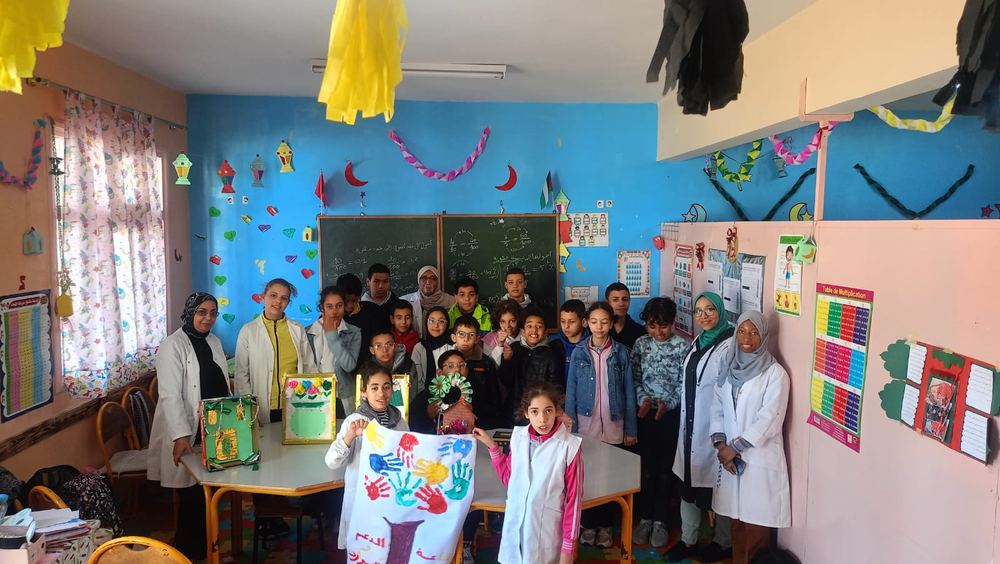
At AMEA, the Educational Unit is not a classroom like any other. It is a place where a child is never forced to learn the way we want him to learn. We learn how he learns. If he learns with pictures, we give him pictures. If he learns by moving, we get him moving. If he learns by repeating the same thing 50 times, we repeat it 50 times with a smile. Our job is not to make him normal. Our job is to give him the tools to be independent, to communicate and to be happy in our world, without ever ceasing to be himself.
1. What is the AMEA Educational Unit?
It is NOT
- A private school
- A centre where children are looked after while parents work
- A place where children colour to pass the time
It is
A multidisciplinary team trained in ASD that works around 3 inseparable axes for each child, with 3 specialised reports - see beneficiary reports section - and 1 measurable individualised plan.
The 3 axes of the Educational Unit
Axis 1 - COMMUNICATE: Without communication, there is no learning. This is the speech therapy/AAC axis
Axis 2 - REGULATE THE BODY: Without a regulated body, there is no attention. This is the psychomotor/sensory axis
Axis 3 - LEARN AND BECOME INDEPENDENT: With communication and a regulated body, we can learn to get dressed, eat alone, read, count, play with another child. This is the purely educational axis.
2. Who works in the Educational Unit? - The multidisciplinary team
At AMEA, a child is never followed by just one person. He is followed by a team that speaks the same language - PECS, TEACCH, Picto.
| Professional | Role in the Educational Unit | Training required by AMEA |
|---|---|---|
| Educational lead / Special educator | Leads the individualised plan, coordinates, links parents and school, runs TEACCH workshops | 40h ASD + PECS + TEACCH + crisis management |
| Speech therapist | Assesses language, sets up AAC - PECS 6 phases, Makaton, TD Snap -, trains parents and AVS | Diploma + 30h AAC + supervision |
| Psychomotor therapist | Dunn sensory assessment, sensory diet, school sensory sheet - see sensory sheet section -, independence at meals/dressing/toileting | Diploma + Dunn sensory profile |
| Psychologist | Parental support, siblings, couple, child's emotional regulation, discussion groups, PSI/HAD | Master's in psychology + ASD training |
| AVS - School Life Assistant | Translator between school and child, applies accommodations, liaison notebook | 40h AMEA + 2-week internship |
| Educational coordinator | Supervises all projects, ensures quality, trains the team | 5 years of ASD experience + trainer |
Every AMEA child has
- 1 single educational lead - his common thread
- 1 speech therapist + 1 psychomotor therapist + 1 psychologist as referents - same team all year
- 1 AVS if in school
- Team meeting every 15 days - 30 min per child - adjusting objectives
3. How do we work? - The 4 proven methods we really use
At AMEA, we do not follow a single fashionable method. We take what works and is ethical.
Method 1: TEACCH - Structuring space and time to make the world predictable
- For whom? 100% of our children
- What is it? Every AMEA room is divided into visual zones: 1-1 work zone, independent work zone, play zone, calm corner zone, meal zone. Each child has his visual schedule with detachable Picto cards. He knows where he is going, what he will do, for how long, and what comes after. Result: less anxiety.
- Example: Instead of saying "Do your exercise", we show: Picto "Work" -> 3 trays to do -> Picto "I'm finished" -> Picto "Play". The child does it alone.
Method 2: PECS and AAC - Giving a way to ask, not forcing speech
- For whom? 70% of our non-verbal or minimally verbal children - see speech therapy report
- What is it? 6 phases: exchanging a picture for an object, distance, discrimination, the sentence I WANT, responding, commenting. We never force anyone to speak. We give a picture. The picture gives power. Power reduces meltdowns.
- Generalisation is compulsory: PECS binder at home + school + transport + grandparents. If PECS stays at the AMEA premises, it is useless.
Method 3: Ethical ABA - Learning in small steps, without shouting, without punishment
- For whom? Independence, school learning
- What is it? We break each task into micro-steps - task analysis. E.g.: washing hands = 8 steps with pictos. We positively reinforce each successful step - not with sweets, but with what the child loves: 2 min of dinosaurs, jumping on a trampoline. We never punish. We re-teach.
- What we DO NOT do at AMEA: punitive ABA, forcing eye contact, preventing stimming that reassures, shouting, isolation. If you see this elsewhere, leave.
Method 4: Sensory approach and regulation - Dunn + sensory diet
- For whom? 95% of our children - see school sensory sheet
- What is it? Dunn sensory profile, personalised sensory diet, breaks every 30 min, calm corner, headphones, regulation objects. A child who is sensorially dysregulated cannot learn anything. We regulate first, we learn after.
4. A typical day in the AMEA Educational Unit - Ain Chock
This is not a daycare. It is a day structured like at school, but adapted.
8:15-8:30 Arrival and regulation
Adapted transport - see transport section - + visual welcome + 2 min sensory diet - trampoline, weighted cushion
8:30-9:15 1-1 work with the educational lead
SMART objective of the plan - e.g.: PECS Phase 3 discrimination 10 pictures - 3 trials, sensory break, 3 trials
9:15-9:30 Sensory break + independence snack
Visual sequence "I wash my hands, I eat, I drink, I clear up"
9:30-10:15 Group workshop of 4 children - Turn-taking and play
TEACCH - each with his own task + cooperative play - pushing a car in turns with picto YOUR TURN / MY TURN
10:15-11:00 Workshop of the day - according to schedule - see extracurricular activities section
Monday sewing effects, Tuesday pottery, Wednesday bakery, Thursday recycled painting, Saturday swimming pool
11:00-11:30 Daily independence
Dressing, toileting, tidying with visual sequences - photos of the child himself doing it
11:30-12:00 Review and liaison notebook
Photo of the child doing the activity + 2 lines for parents + pictos for the child "Today I did..."
Afternoon: Parent guidance, AVS training, psychological support, discussion groups - parents take over
Numbers: 6 children maximum per group, 2 educators - ratio 1 for 3 - never more.
5. The Individualised Plan - PAPÉ - The document that makes the difference
Every AMEA child has a PAPÉ - Personalised Educational Support Plan - lasting 6 months, with 3 SMART objectives.
Example of a PAPÉ: Youssef, ASD Level 2Illustrative example, to be replaced by a real anonymised case
Objective 1 - COM - Speech therapy: Go from 0 to 10 spontaneous requests/day with PECS Phase 3 in 3 months
Means: Binder of 20 pictos, training for mum + AVS, 10 trials/day, video modelling
Measure: Daily count in the liaison notebook
Objective 2 - INDEPENDENCE - Psychomotor: Put on his top alone with a 4-step visual sequence in 3 months
Means: Photo sequence of Youssef himself, TEACCH dressing task, timer, specific praise
Measure: % of steps done alone /8 - initial 0% -> target 80%
Objective 3 - SOCIAL - Educational: Stay 15 min in a group workshop of 4 children without a meltdown, with sensory breaks, in 3 months
Means: Calm corner nearby, breaks every 10 min, buddy tutor, sensory diet
Measure: Duration in min + number of meltdowns
Reassessment every 3 months with the 3 specialised reports - see reports section - and adjustment.
6. The link with the inclusive school - We do not replace school, we make it possible
The AMEA Educational Unit is not a substitute school. It is the support that makes ordinary school possible.
- Morning: Child at ordinary school with an AMEA-trained AVS + sensory sheet + accommodations - see sections inclusive school and sensory sheet
- Afternoon: 2 afternoons/week at the Educational Unit to work on what school cannot work on in a large group - PECS, independence, regulation
- Link: A single AMEA-school liaison notebook - same pictos - quarterly meeting parents + teacher + AVS + AMEA lead + speech therapist + psychomotor therapist
Without support, school alone cannot do everything and inclusion risks failing. With the Educational Unit + AVS + sensory sheet, inclusion holds up much better.
7. How much does it cost and how is the Educational Unit funded?
Actual cost to AMEA
- Special educator: 4000 DH/month for 6 children = 666 DH/child/month
- Speech + psychomotor + psychologist: 3 sessions/month/child = 900 DH
- Materials - PECS, pictos, TEACCH, sensory: 200 DH/month/child
- Total: 1766 DH/month/child
AMEA family contribution
- 300 DH/month: single flat fee, to cover running costs
- Free for vulnerable families - AMO Tadamon - on application
- The rest is funded by Entraide Nationale agreements + INDH + donations - see social support section
This is much cheaper than an untrained private centre at 4000-6000 DH/month that has neither reports nor proven methods.
8. What AMEA offers - Educational Unit enrolment 2026
- Educational Unit entry assessment - 3 assessments psychologist + speech + psychomotor + 6-month PAPÉ - 800 DH - initial overall report + 3 specialised reports - 1 week
- Educational Unit care 2 half-days/week - groups of 6 children max - 300 DH/month, single flat fee - with liaison notebook + photos
- Intensive care 4 half-days/week - for children not in school or waiting for a school place - 300 DH/month, single flat fee
- 6h parent training "Understanding the Educational Unit and continuing at home" - 200 DH - with starter PECS kit
The AMEA Educational Unit is not a place where your child is put because nobody knows what else to do with him. It is the place where your child is taught to do alone what he could not do yesterday, and where you, the parents, are taught to become the best educators of your child. Because the best educator of an autistic child is not us. It is you, once you have been given the right tools.